Welcome to a Paradise for Children! Skopelos is a small world of enchantment, where children learn through play and exploration. In this safe and secure environment, kids are led through an exciting and a stimulating round of activities every single day.
The Sporades, off the coast of Greece, are a line of islands stretching out into North Aegean. Once a refuge for pirates, known variously as Satan's Islands, Demon Islands, Thieves' Dens and the islands of the Magnesians, the Northern Sporades - literally meaning 'scattered' - with their dramatic changes from island to island, strange geological forms and historical remains, are among Greece's most delightful secrets. The three islands nearest the mainland, Skiathos, Skopelos and Alonissos, are generally well known to visitors. However the islands further out are not so well known and retain the feel and charm of an older era. This area is well known to flotilla and other yacht sailors for whom it provides a quieter cruising area than the Ionian, the busier counterpart on the Greek west coast. A constellation of glittering jewels scattered across the Aegean Sea, the Sporades are some of Northern Greece's best-kept secrets. Beyond Alonnisos there are: Perister...
Old photos present a unique view of our past. Here it is a glimpse of Skopelos’ past in the form of old photographs. The past is idealized by presenting its faded photographic remains as proof of an irrevocably lost simplicity and innocence.
Agios Petros (St. Peter) is a deep bay on the southwest side of Kyra Panagia - the second island one encounters after Peristera in the National Marine Park of Northern Sporades. St. Peter's bay is a safe, natural haven.
Paul and Jasmine live in Florida, but Paul’s roots are in Greece. The island of Skopelos was his father’s (and grandfather’s, and great grandfather’s...) home and is brimming with cousins and family members, who recognize him on sight and treat him as family. So when they decided on an intimate wedding, Greece was the obvious choice – and I was honored to be invited to join them on the journey and photograph the day. Jasmine spent the morning preparing in their home in Skopelos town, and they chose the incredibly stunning Amarandos (“The Point that Never Withers”) for their actual ceremony – the most remote and striking ceremony location I’ve ever had the chance to photograph. Text and Photos by Aislinn Kate at aislinnkatephotography.com
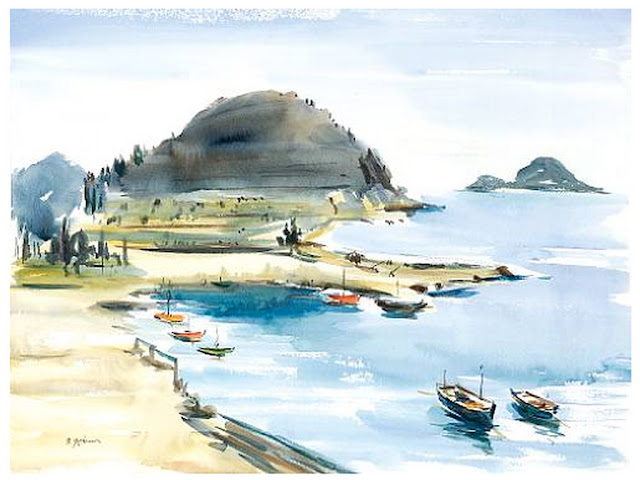
Paris Prekas (1926-1999) was a well-known Greek artist, some of his works are exhibited in the National Gallery of Athens. He studied at the School of Fine Arts (1948-1952) under Umvertos Argyros, Dimitrios Biskinis and Andreas Georgiadis while in 1963, on a six month scholarship from the French government, he did post-graduate work in Paris. His artistic activity includes solo presentations and appearances in group and international exhibitions, such as the Youth Biennale of Paris in 1959, and the Sao Paolo and Alexandria Biennales of 1965 and 1968 respectively, at which he repeatedly won distinctions. A multifaceted creator, Prekas has been involved with painting, sculpture, decorative design and architectural ornamentation, making compositions for the interior and exterior spaces of apartment buildings and other public and community buildings. In painting he was originally involved with landscape while later, combining Greek reality with myth and tradition, he created thematic whole...
At the rocky coast of Amarandos you can enjoy a tranquil and peaceful swim. From the main bus road, between Stafylos and Agnontas, there is a dirt road on the left, through the forest, that leads to several secluded little rocky coves, perfect for snorkeling. Pine trees sweep down to the water's edge offering privacy and shade. Click on the link for photos from the area → Amarandos, Skopelos
Skopelos is an unspoiled jewel in the Aegean Sea, with mountain slopes bedecked in dense greenery carpeting down to fine beaches and limpid waters. Despite being small, Skopelos beaches are varied and aplenty: find olive trees and plum orchards and clumps of pines by the sea’s edge, composed of slender pebbled shores or white bays, caves and coves, plus curious rock formations. (tip) Make sure to pack snorkeling goggles for swimming with curious marine life, especially around the cragged rocks. Spot the occasional turtle and fish of all stripes! The most popular of Skopelos beaches lie on the more wind-sheltered west coast, home to stretches of white shingle and pebbles backed by bars and taverns. On the flip side, the eastern shoreline is peppered with smaller and more peaceful beaches, almost always deserted. Likewise, those in the north are wilder with no facilities. Keep in mind that as a Greek island, strong Meltemi (dry and seasonal) winds can affect some of Skopelos’s beaches in...
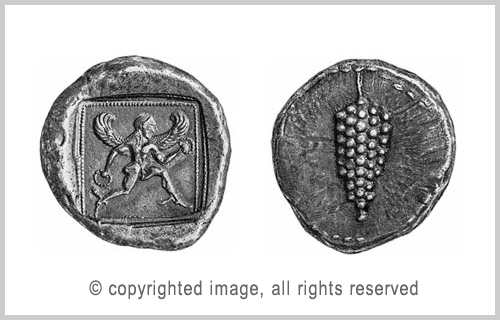
This very rare flat silver tetradrachm from the ancient Greek island of Peparethos (Skopelos) from 500-480 B.C. is exhibited in the British Museum. OBVERSE: Running winged figure in incuse square. This figure is probably Agnon, the runner Olympic winner. REVERSE: Large bunch of grapes between two small leafs in a dotted circle. The type of this coin suggests trade relations with other cities, chiefly with Chalkidiki and Cos island, where some of them have been found.